 Guide
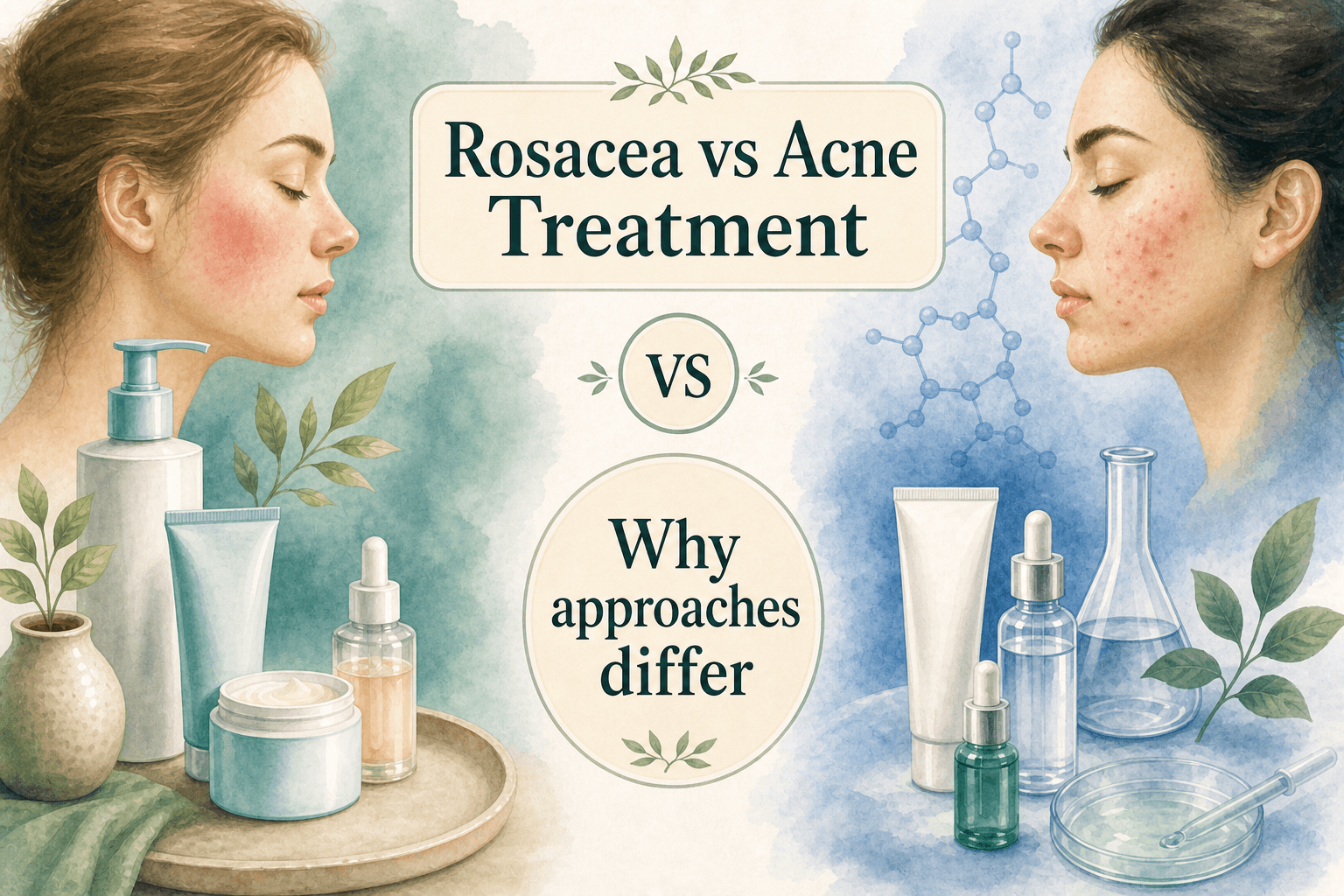
GuideRosacea vs Acne Treatment: Why the Approach Differs
Acne and rosacea treatments are not interchangeable. Learn why approaches differ, which common acne actives can irritate rosacea-prone skin, and what clinicians typically match to each condition.

Rosacea Beauty Editorial Team
Jul 22, 2026 · 9 min read
Rosacea and acne can both cause red bumps on the face, but treatment approaches are not the same. Acne care often targets clogged pores and Cutibacterium acnes–related inflammation. Rosacea care focuses on calming inflammatory and vascular features, protecting a reactive barrier, and matching therapy to the signs present — redness, vessels, papules, or eyes. Using a strong acne routine on undiagnosed rosacea is a common reason skin burns, stings, and flares.
Why acne and rosacea need different approaches
Acne vulgaris is largely a disorder of the pilosebaceous unit: excess oil, clogged pores (comedones), inflammation, and bacteria. Over-the-counter and prescription acne care often includes benzoyl peroxide, salicylic acid, and retinoids to unclog pores and reduce lesions. Rosacea is a chronic inflammatory condition with neurovascular and immune features. Modern guidance treats the phenotypes you have — persistent erythema, flushing, papules/pustules, telangiectasia, ocular signs — rather than one fixed “acne-style” stack.
- Acne logic: clear comedones, reduce oil/bacterial drivers, prevent scarring.
- Rosacea logic: reduce inflammation and reactivity, manage triggers, treat the features present.
- Shared need: gentle cleanser, moisturizer, and daily sun protection — especially when skin is burning.
Treatment approaches at a glance
Primary goal
Rosacea approach
Calm inflammation, reactivity, and vascular features
Acne approach
Unclog pores and reduce inflammatory acne lesions
Typical OTC tools
Rosacea approach
Barrier-first care; fragrance-free basics; avoid harsh scrubs
Acne approach
Benzoyl peroxide, salicylic acid, adapalene/retinoids (as tolerated)
Common prescription topicals
Rosacea approach
Ivermectin, metronidazole, azelaic acid; agents for lasting redness when appropriate
Acne approach
Stronger retinoids, combination acne gels, sometimes antibiotics as directed
Oral options (selected cases)
Rosacea approach
Anti-inflammatory strategies chosen for rosacea severity/features
Acne approach
Oral acne medicines when topical care is not enough (clinician-directed)
Devices
Rosacea approach
Laser/IPL may help persistent color and visible vessels
Acne approach
Procedures sometimes used for comedones or scarring — different goals
Common pitfall
Rosacea approach
Stacking acne actives → burning, barrier damage, more redness
Acne approach
Undertreating true comedonal acne if everything is treated as “sensitivity” only
What clinicians often use for rosacea features
For inflammatory papules and pustules of rosacea, evidence-supported topicals include ivermectin, metronidazole, and azelaic acid. Persistent facial color may be addressed with prescription agents that temporarily reduce erythema, and vascular laser or intense pulsed light may be discussed for vessels and lasting redness. Care is phenotype-led: eyes, bumps, and redness are not treated with one identical product stack.
- Foundation: gentle cleanse, moisturizer, broad-spectrum SPF every day.
- Inflammatory bumps: clinician-selected topical anti-inflammatory / antiparasitic options.
- Persistent redness: medical options and/or light-based care when appropriate.
- Triggers: heat, sun, alcohol, spicy food, stress — personal, not universal bans.
What acne care usually emphasizes
The American Academy of Dermatology highlights matching acne products to lesion type — blackheads, whiteheads, papules, pustules, or deeper cysts. Benzoyl peroxide and salicylic acid are common starting points for many inflammatory bumps; retinoids help keep pores clear. Deep cystic acne often needs a dermatologist and prescription therapy. Those tools can help true acne — and still be the wrong first move when the pattern is rosacea without comedones.
Why acne actives can worsen rosacea-prone skin
Rosacea-prone skin often burns, stings, and flushes. Scrubs, high-strength acids, alcohol-heavy toners, and stacking multiple acne actives can damage the barrier and increase redness. AAD materials on stubborn “acne” note that papulopustular rosacea can mimic breakouts — and that sensitive, stinging skin is a clue you may not be dealing with ordinary acne. If products that “should” clear acne make color and discomfort worse, pause escalation and get assessed. Reset with a rosacea-friendly skincare routine while you wait.
What if you might have both?
Acne and rosacea can coexist. Clinicians usually clarify which lesions are comedones versus inflammatory rosacea bumps, calm the barrier first when skin is reactive, then stage treatments so irritants are not stacked. Papulopustular rosacea is the pattern most often mistaken for adult acne — appearance alone is not enough to choose a protocol.
Questions to ask your clinician
- Do I have acne, rosacea, or both — and which lesions are comedones?
- Which products should I stop while we treat inflammation or barrier damage?
- If a prescription is needed, is it aimed at redness, bumps, vessels, or eyes?
- How long should I trial a therapy before we change course?
- Is laser or light appropriate for my vessels/color after medical care?
Sources
Reviewed against guidance and consensus from established medical organizations.
- 1.American Academy of Dermatology. Rosacea: Diagnosis and treatment (opens in a new tab)
- 2.American Academy of Dermatology. How to treat different types of acne (opens in a new tab)
- 3.American Academy of Dermatology. Is that acne or rosacea on your skin? (opens in a new tab)
- 4.National Institute of Arthritis and Musculoskeletal and Skin Diseases. Acne (opens in a new tab)
- 5.National Institute of Arthritis and Musculoskeletal and Skin Diseases. Rosacea (opens in a new tab)
- 6.Cochrane / British Journal of Dermatology (PMC). Interventions for rosacea based on the phenotype approach: an updated systematic review (opens in a new tab)
- 7.American Academy of Family Physicians. Rosacea: Common Questions and Answers (opens in a new tab)
Comments(0)
No comments yet.
