 Guide
GuideCouperose vs Rosacea: What's the Difference?
Couperose often describes facial redness and visible vessels, while rosacea is a broader inflammatory condition. Learn why the labels get confused, when “couperose” may actually be rosacea, and how clinicians assess the difference.

Rosacea Beauty Editorial Team
Jul 22, 2026 · 8 min read
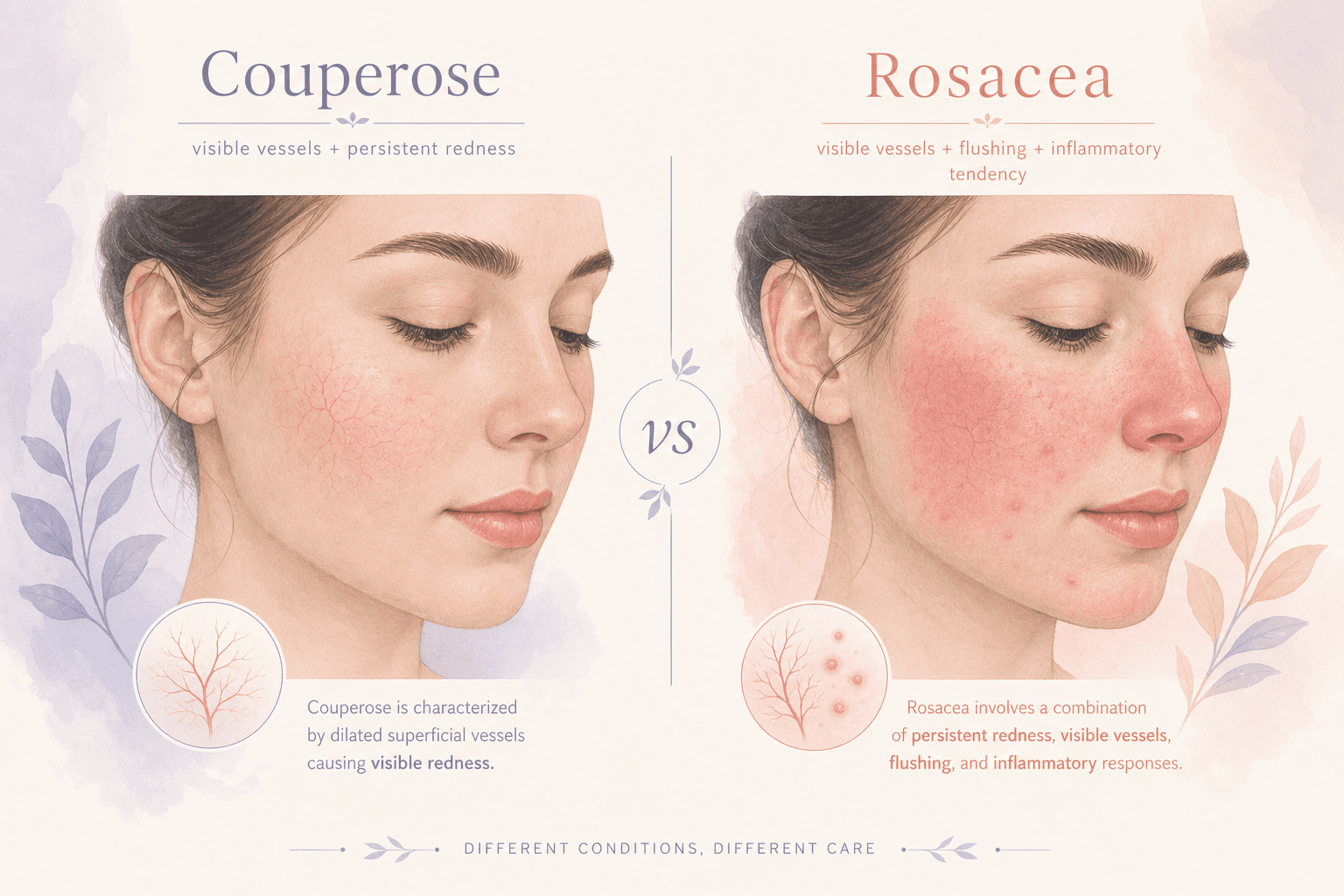
Couperose and rosacea are often used as if they mean the same thing — especially in European beauty and spa language — but they are not identical clinical labels. “Couperose” usually describes facial redness and fine visible blood vessels. Rosacea is a chronic inflammatory condition that can include those vessel changes and more: flushing, lasting central facial color, papules or pustules, eye symptoms, or thickened skin. Treating redness as “just couperose” can miss a fuller rosacea picture and delay the right care.
What does “couperose” mean?
Couperose (from French usage; similar everyday terms appear in other European languages) is commonly used for a red, reactive face with spider-like or thread-like vessels. In everyday and cosmetic contexts it often points to telangiectasia plus erythema. It is not a separate formal diagnosis in American Academy of Dermatology or NIH patient materials, which discuss rosacea and its signs instead.
- Typical couperose description: lasting or frequent facial redness, fine visible vessels, sensitive skin.
- Often focused on cheeks and nose — the same central-face zone as many rosacea presentations.
- May be discussed as a “skin type” in beauty settings even when a medical assessment would use rosacea criteria.
What is rosacea, by comparison?
Rosacea is a long-term inflammatory condition of the face (and sometimes the eyes). AAD and NIH describe flushing, lasting color, acne-like bumps, visible vessels, eye irritation, and thickened skin. What is rosacea? summarizes the full picture. The pattern once labeled erythematotelangiectatic rosacea — flushing, persistent color, and vessels — is the closest clinical match to what people call couperose. See erythematotelangiectatic rosacea for that presentation in detail.
Couperose vs rosacea at a glance
What it is
Couperose (common usage)
Descriptive label for redness and visible vessels
Rosacea (clinical)
Chronic inflammatory diagnosis defined by clinical features (phenotypes)
Main look
Couperose (common usage)
Erythema + telangiectasia, often central face
Rosacea (clinical)
May include flushing, lasting color, vessels, bumps, ocular signs, or phymatous change
Guidelines
Couperose (common usage)
Not a standalone category in AAD/NIH rosacea materials
Rosacea (clinical)
Diagnosed clinically; phenotype-based management (ROSCO and related guidance)
Scope
Couperose (common usage)
Usually vessel/redness-focused language
Rosacea (clinical)
Broader: skin and sometimes eyes; features can overlap or change over time
Care focus
Couperose (common usage)
Often cosmetic calmers, barrier care, or vessel-targeting procedures
Rosacea (clinical)
Feature-matched medical care: gentle routine, triggers, prescriptions, laser/light when appropriate
Risk of the label
Couperose (common usage)
May understate a chronic inflammatory condition
Rosacea (clinical)
Supports monitoring for flares, eyes, and overlapping phenotypes
Why is the diagnosis often wrong or incomplete?
Mislabeling is common because the visible clues overlap. Someone with flushing and vessels may hear “couperose” in a salon or spa, or receive only vessel-focused advice, while a clinician using rosacea criteria would also ask about bumps, burning, triggers, and eyes. Global consensus guidance moved from rigid subtypes to phenotypes partly because features overlap — so a vessel-only label can be too narrow.
- Shared signs: both conversations center on redness and telangiectasia.
- Language gap: European cosmetic language vs English-language medical terms (rosacea / ETR).
- Incomplete history: no review of ocular symptoms, papules, triggers, or product intolerance.
- Photo timing: vessels look clearer in flares; intermittent flushing is easy to miss between visits.
- Treatment first, diagnosis second: laser or cosmetic “couperose” care without assessing full rosacea risk.
- Look-alikes: sun damage, seborrheic dermatitis, contact reactions, and other causes of facial redness.
How clinicians sort it out
Rosacea is diagnosed clinically. There is no single blood test. Assessment includes distribution of color, vessel pattern, sensitivity, bumps, eye symptoms, medicines, and triggers. International updates emphasize diagnosing and treating the features present — persistent centrofacial erythema is a key diagnostic feature, with major features such as flushing, papules/pustules, telangiectasia, and ocular involvement.
Does care differ?
If the only issue is fragile vessels and mild redness, gentle barrier care, sun protection, trigger awareness, and — when appropriate — vascular laser or light therapy may still be discussed. If the pattern meets rosacea criteria, care is matched to each feature (color, vessels, inflammatory lesions, eyes). Aggressive peels, harsh “vascular” cosmetics, and stacked irritants can worsen burning and flares. Start from a rosacea-friendly skincare routine while you seek assessment.
When to see a clinician
- Redness or visible vessels keep returning, spreading, or stinging.
- You were told you have “couperose” but also have bumps, eye grittiness, or strong flushing.
- Over-the-counter “couperose” products burn or increase color.
- You want clarity before booking laser or light treatment for vessels.
Erythematotelangiectatic rosacea
Flushing, lasting color, and visible vessels — the pattern closest to “couperose.”
Read the guideWhat is rosacea?
Symptoms, presentations, and how clinicians approach diagnosis.
Read the guideRosacea vs acne
Another common mix-up when facial bumps and redness overlap.
Read the guideSources
Reviewed against guidance and consensus from established medical organizations.
- 1.American Academy of Dermatology. Rosacea: Signs and symptoms (opens in a new tab)
- 2.American Academy of Dermatology. What is rosacea? (opens in a new tab)
- 3.National Institute of Arthritis and Musculoskeletal and Skin Diseases. Rosacea (opens in a new tab)
- 4.Global ROSacea COnsensus panel. Recommendations for rosacea diagnosis, classification and management: 2019 update (opens in a new tab)
- 5.National Rosacea Society Expert Committee. Standard classification and pathophysiology of rosacea: 2017 update (opens in a new tab)
- 6.StatPearls / NCBI Bookshelf. Rosacea (opens in a new tab)
Comments(0)
No comments yet.
