 Guide
GuideDemodicosis & Rosacea: The Demodex Mite Connection
What Demodex mites are, how demodicosis relates to and differs from rosacea, how it is diagnosed, and evidence-based care.

Rosacea Beauty Editorial Team
Jul 19, 2026 · 6 min read
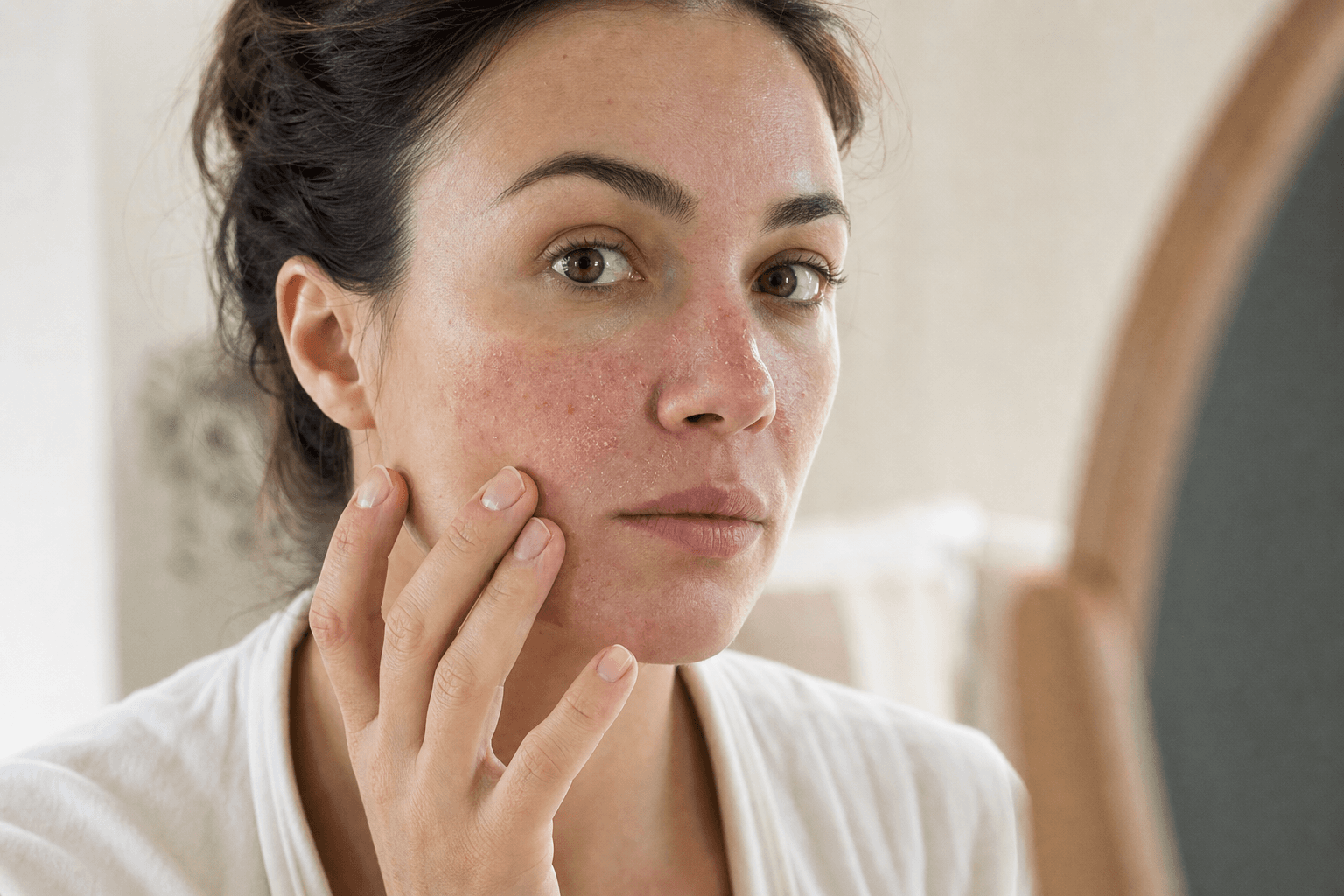
Demodex are microscopic mites that naturally live in the hair follicles and oil glands of almost every adult's face. Usually they cause no problems. Demodicosis is the term used when these mites are present in unusually high numbers and are linked to skin inflammation — an appearance that can look very similar to rosacea.
How demodicosis can differ from rosacea
- Lesions are often small, superficial papules and pustules that appear in clusters.
- Fine, dry, sandpaper-like scaling (a rough texture) is common.
- Distribution can be asymmetrical, rather than the symmetrical central-face pattern typical of rosacea.
- Onset may be relatively sudden, without a long history of flushing.
- It may respond poorly to standard rosacea therapy while improving once mite numbers are reduced.
Who is more susceptible
Higher Demodex densities and mite-related inflammation are reported more often in people with rosacea and in those whose immune response is altered — for example during immunosuppression or certain illnesses. This is one reason self-diagnosis is unreliable and professional assessment matters.
How it is diagnosed
There is no at-home test. A clinician considers the pattern of lesions, scaling, symmetry, and history, and may confirm high mite density with a simple skin surface scraping examined under the microscope or with non-invasive techniques such as dermoscopy or standardized skin surface biopsy.
Evidence-based care
- Gentle cleansing, barrier-supporting moisturizer, and daily sun protection remain the foundation.
- Clinicians may prescribe topical antiparasitic treatments (such as ivermectin) that target Demodex-related inflammation.
- Oral therapy is considered in selected or more resistant cases.
- Cases previously unresponsive to rosacea therapy sometimes improve once mite-related inflammation is addressed.
- Avoid unproven "mite-killing" home remedies and harsh routines, which can worsen irritation.
Sources
Reviewed against guidance and consensus from established medical organizations.
- 1.National Rosacea Society. Causes of Rosacea: Demodex Mites & Microbes (opens in a new tab)
- 2.National Rosacea Society. The Ecology of Your Face: Demodex, Rosacea and You (opens in a new tab)
- 3.American Academy of Dermatology. Rosacea: Diagnosis and treatment (opens in a new tab)
- 4.Global ROSacea COnsensus panel. Recommendations for rosacea diagnosis, classification and management: 2019 update (opens in a new tab)
Comments(0)
No comments yet.
